

Miloslav Troup
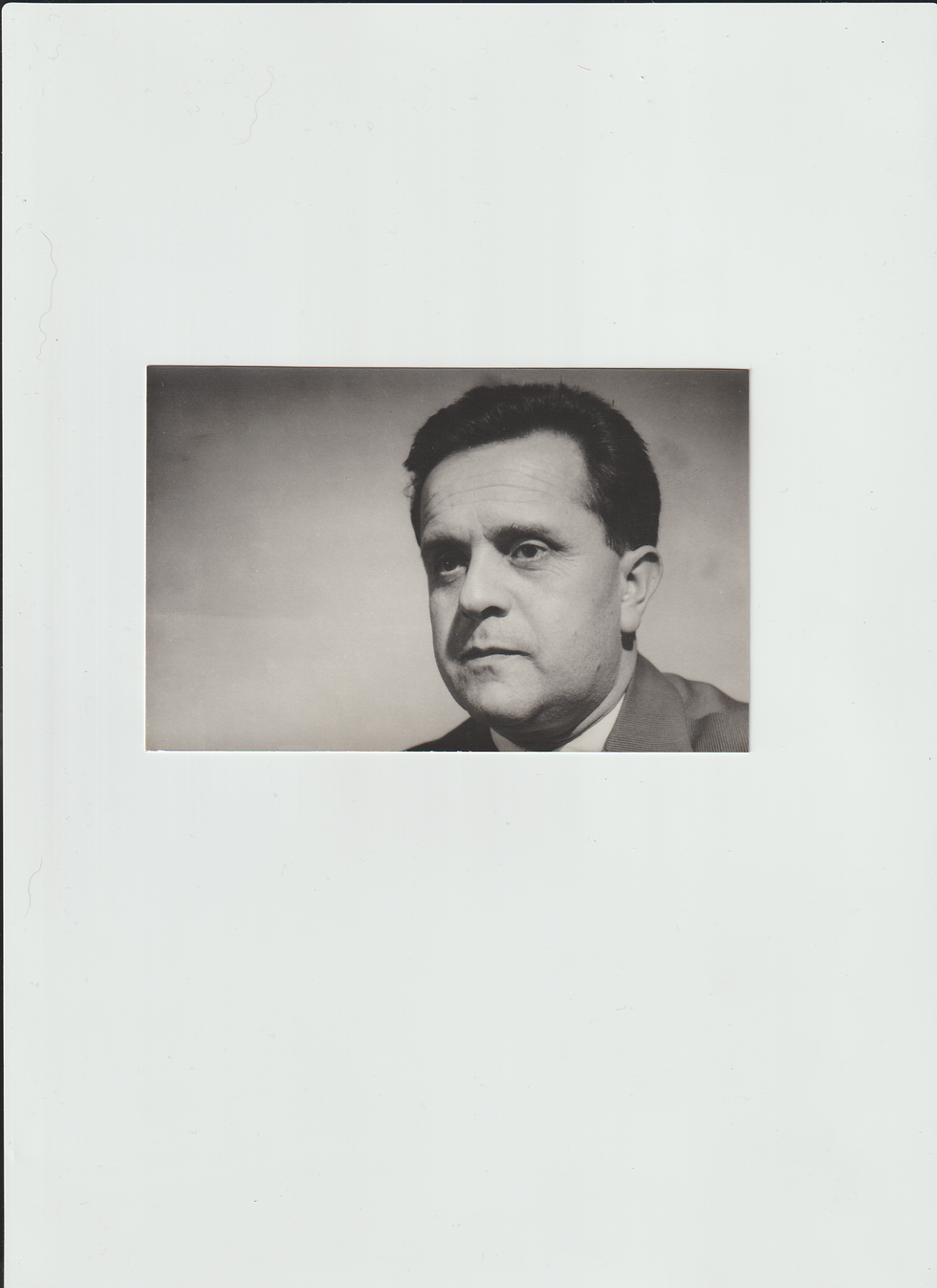
Miloslav Troup (June 30, 1917, Hořovice – February 22, 1993, Prague) was a Czech painter, illustrator, graphic artist and typographer. In his free work, he developed a lyrical-symbolic style that places him in the circle of the Second Paris School (Nouvelle École de Paris). His work combines delicate color, ornamental rhythm and spiritual themes. During his stay in Paris, he understood the legacy of Cubism and Fauvism in order to create a unique and unrepeatable picture of the world from this rich material. He was the author of illustrations for more than 140 book titles, a designer of stained glass windows and tapestries. His works are represented in important Czech, Moravian and foreign collections.
Life
Troup was born into a family of a railway inspector as the middle of seven children. He spent his childhood in Hořovice and later in Hluboká nad Vltavou, where his strong connection to South Bohemia was formed. After incomplete grammar school, he studied at the State Graphic School in Prague (1934–1936), majoring in bookbinding. He subsequently graduated from the Academy of Applied Arts in Prague (1936–1942) under Prof. Jaroslav Benda, where he focused on book graphics. In 1945, he received a scholarship from the French government and studied in Paris at the École nationale supérieure des Arts Décoratifs under François Desnoyer and at the École des Beaux Arts under Maurice Brianchon.
In Paris, his friend and mentor was the art historian Václav Nebeský, who, together with the French critic Pierre Descargues, helped Troup establish contacts with important artists of the time, such as Oscar Dominguez, André Lhote, Georges Braque, Pablo Picasso and Serge Poliakoff. His studio in the Parisian district of Ivry was also visited by František Kupka. Thanks to these contacts, Troup was able to actively participate in the artistic life of Paris. This opened the door not only to inspiration, but also to professional growth in the artistic environment, which fundamentally influenced Troup's orientation and overall artistic direction.
During his stay in Paris, he gradually became close to the circle of the Second Paris School. He exhibited with the collectives Peintres d'aujourd'hui and Jeune École de Paris. He received opportunities to illustrate and his artistic career was heading for a remarkable rise. However, at the end of the 1940s, events connected with the beginning of the Cold War entered Troup's life. He was faced with the decision of whether to continue his promising career as a painter in France or to abandon it and return to Czechoslovakia, which after 1948 became a communist dictatorship controlled from Moscow. Despite the warnings of his family and the fact that great prospects were opening up for him in Paris, Miloslav Troup's longing for home prevailed and at the beginning of 1950 he returned to Czechoslovakia.
After returning to Prague, he faced misunderstanding and rejection of his modern artistic vision. Nevertheless, he continued to work in his studio on Veleslavín Street. His relationship with literature, history, fairy tales, legends and children's literature directed him towards book illustration, which became an important part of his work. In the 1960s, he married the painter Marie Vindišová and moved to Mala Strana. This marked the beginning of his long-term work on the monumental set of canvases of the Prague Cycle. In the 1960s, Troup established cooperation with the Alšova South Bohemian Gallery in Hluboká nad Vltavou and designed a series of tapestries for it. He regularly visited the family of his brother Zdeněk, a pharmacist from Prachatice. From foreign travels
His work was influenced by Croatian Dalmatia and later northern Italy, which he repeatedly visited in connection with his ailing wife's medical stays. February 22, 1993 MILOSLAV TROUP dies in Prague, buried in the cemetery in Prachatice.




A few facts from the life of Miloslav Troup
1993
1985
1980
1975
1968
1966
1965
1963
1958
1954
1950
1945 - 1948
1936 - 1942
June 30, 1917
February 22nd dies in Prague
Exhibition in Denmark
Exhibition in Bologna
Creative stay in Italy.
Illustration: Images from the History of the Czech Nation, Vladislav Vančura
UNESCO Prize for the best illustration at the Frankfurt Book Fair.
Marriage to Marie Vindišová, accompanied by a change of residence. From the apartment at 33 Nerudova Street, he walks daily to his Old Town studio, gathering inspiration for the Prague Cycle.
Gold Medal at the International Biennial of Book Illustration in São Paulo.
Creative focus gradually turned more toward book illustration.
-
1958 – Illustrations for The Legend of Saint Catherine
-
1958 – Illustrations for The Lusitanians by Luís de Camões
-
1960 – Illustrations for Message from the East by Muhammad Iqbal
-
1960–1990 – He illustrated around 150 book titles, many of which received international awards.
In the first half of the 1950s, a long‑term collaboration began with the architect Jaroslav Čermák and his construction workshop. This resulted in a large series of works with Christian themes, which were used to decorate churches and chapels in Bohemia and Moravia (Pitín, Čestice, Olomouc, etc.).
The beginning of his career in Prague. He constantly experiments and connects Parisian inspiration with perceptions from his surroundings - especially from Prague and South Bohemia. He set up an attic studio in the Old Town at Veleslavínova Street No. 6
Studies in Paris. Becomes a leading figure of the 2nd Parisian School. Meets Kupka, Braque, Poliakoff and Picasso. Discovers colors for himself and the whole world.
Studies at the Academy of Fine Arts and Design in Prague with Professor Benda.
Born in Hořovice into the family of a railway inspector.